







In a historic milestone for higher education in the region, the Abra State Institute of Sciences and Technology (ASIST) has successfully strengthened its global presence through participating, for the very first time, in the prestigious Times Higher Education (THE) Sustainability Impact Ratings.
The THE Sustainability Impact Ratings are global performance tables that assess higher education institutions based on their dedication and real-world contributions to the United Nations’ 17 Sustainable Development Goals (SDGs). By evaluating universities across the essential areas of research, stewardship, outreach, and teaching, these ratings provide immense value. They highlight how institutions act as catalysts for positive societal transformation and environmental harmony, steering the global community toward a balanced and prosperous future.
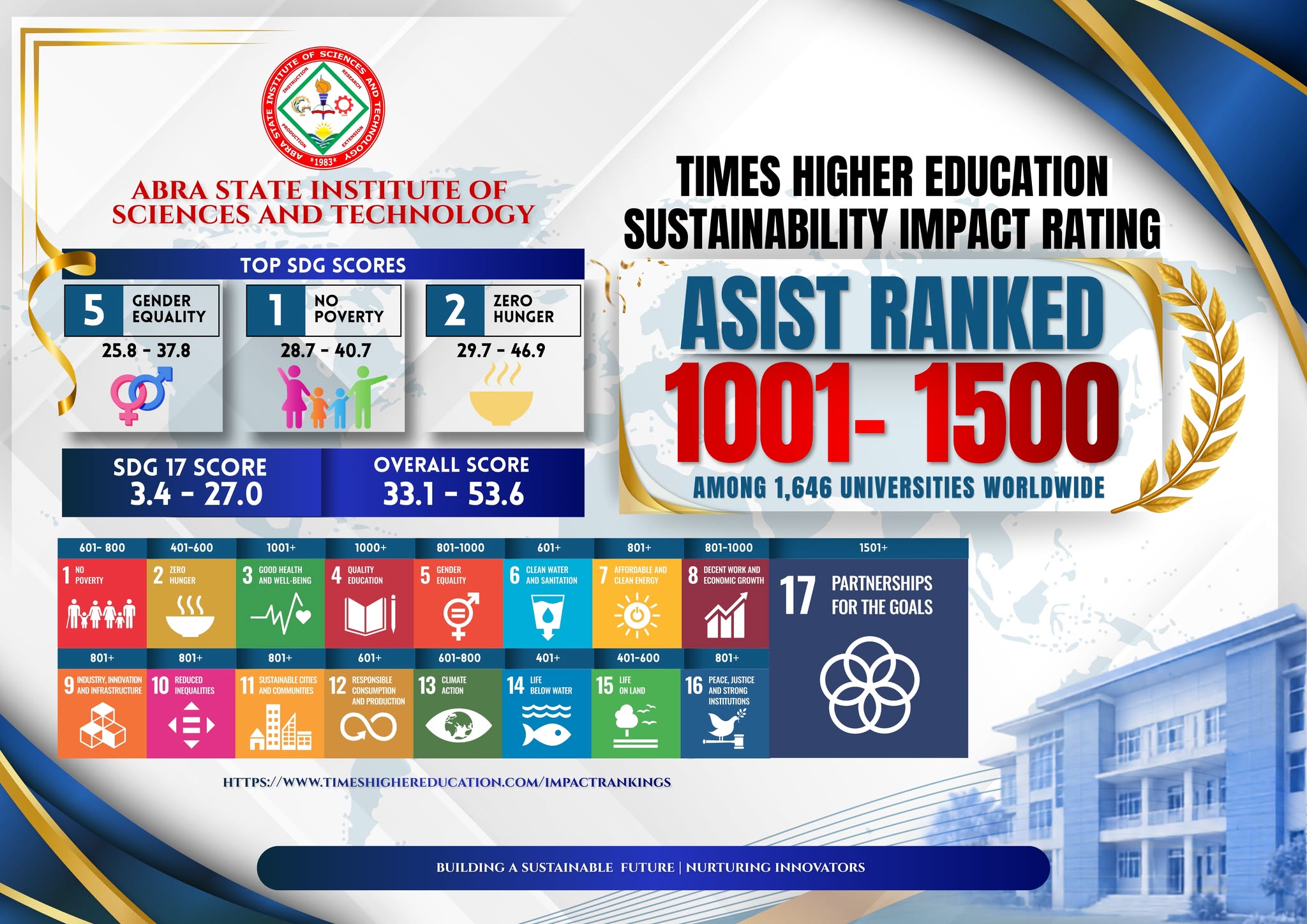
For the 2026 edition, a highly competitive and vast field of 1,646 universities and schools from 116 countries and territories were evaluated. In its magnificent debut, ASIST achieved an overall global ranking of 1001–1500. This position reflects the institution's profound dedication to global citizenship and sustainable progress.
Among the 17 individual SDGs evaluated, ASIST earned outstanding recognition and secured its highest marks in three vital areas:
- Gender Equality (SDG 5): Promoting inclusivity, balanced representation, and equal opportunities for everyone within the academic community.
- No Poverty (SDG 1): Creating pathways for socio-economic advancement through accessible education and targeted community empowerment programs.
- Zero Hunger (SDG 2): Advancing agricultural innovation, food security initiatives, and nutritional advocacy to support the local population.
This monumental achievement is a beautiful reflection of unified dedication. Every individual within the ASIST community—from the visionary leadership and brilliant faculty members to the hardworking support staff and enthusiastic students—shares the honor of this success. Every daily effort, every research paper, and every community extension program have contributed a vital brick to building this international recognition.
As ASIST marks this brilliant chapter in its history, the institution firmly establishes itself not just as a center of learning, but as a beacon of hope and sustainable progress. The journey has officially begun, and the horizon is filled with infinite possibilities as ASIST continues to lift its community and inspire the world.